Spanish Market Analysis
Analysis of the Spanish energy market is key to understanding the dynamics and trends affecting the sector both locally and internationally. In this detailed analysis, we address the important factors influencing energy prices, supply and demand, and the latest regulatory policies. This comprehensive overview will allow you to keep up to date with weekly changes and anticipate possible market variations, both in Spain and in other relevant markets such as France.
August 2026June 2026
Table of Contents
Key figures of the month
Source: Haya Energy Solutions
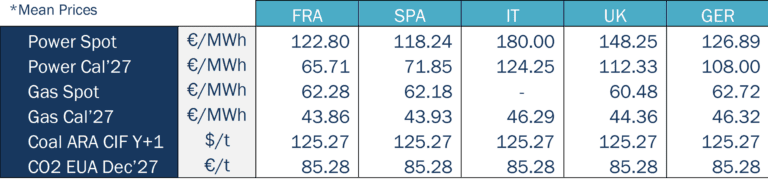
In August 2026, electricity spot prices increased sharply across most major European markets. The upward movement was also visible in the forward market, with Power Cal’27 rising across all countries, largely supported by higher gas prices. More broadly, the increase in energy prices added renewed inflationary pressure to the European economy, particularly through higher electricity and fuel costs.
Spain, France and Germany remained in the lower range of monthly average electricity prices, between 115 and 130 €/MWh. Spain was the lowest-priced power market in the region, with an average price of 118.24 €/MWh, despite an increase of around 15 €/MWh compared with July. France ranked second, averaging 122.80 €/MWh, while Germany followed at 126.89 €/MWh.
By contrast, the UK recorded an average monthly price close to 150 €/MWh. Italy once again stood out as the highest-priced market, averaging around 180 €/MWh and moving closer to the 200 €/MWh level. This reflects the Italian generation mix’s greater dependence on gas-fired technologies. As a result, sharp increases in natural gas prices, such as those observed during August, tend to feed through more directly into wholesale electricity prices.
Overall, several European power markets recorded price peaks not seen since early 2023, highlighting the magnitude of the upward repricing experienced during the month.
At the same time, August also saw new daily solar PV generation records across several major European markets. New all-time daily highs for August were reached in Germany (491 GWh), Spain (277 GWh) and France (190 GWh).
On the gas side, average spot prices stood broadly within the 60–62 €/MWh range across most markets. Compared with July, gas prices increased across all countries, while Gas Cal’27 also moved higher on a month-on-month basis across all markets.
As has been the case since the outbreak of the conflict, gas price formation remained largely driven by developments involving Iran, Israel and the United States. A more detailed review of the main developments during August and their impact on gas prices is provided in section 3.
As for CO₂, prices increased from around 84 €/t in July to 85 €/t in August, extending the upward trend observed over recent months. The monthly average in August was the highest recorded since February 2026. Overall, the month was characterised by broad-based increases across the main energy commodities, with electricity, natural gas and CO₂ all moving higher.
Energy demand and generation mix
Source: Haya Energy Solutions
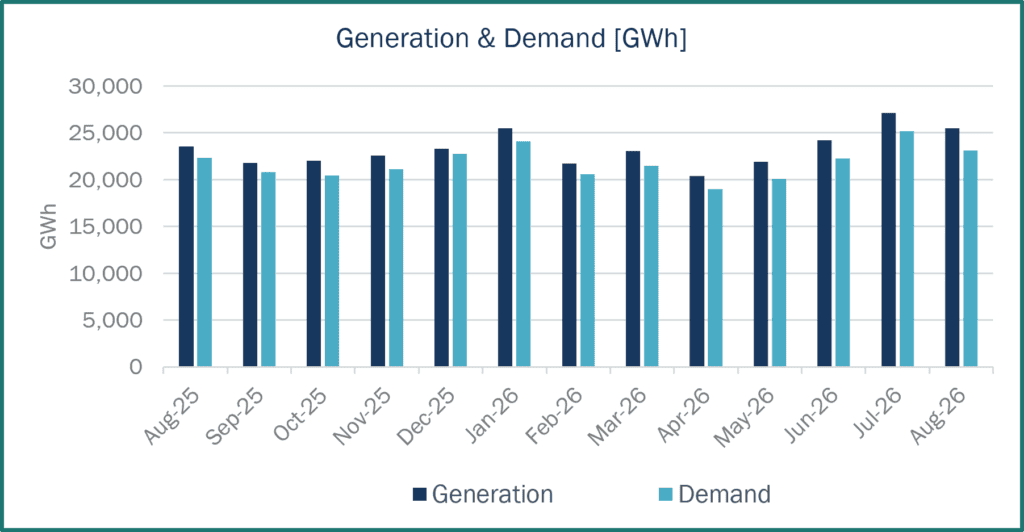
Spanish electricity demand reached 23,137 GWh in August 2026, while total generation stood at 25,462 GWh. Of this volume, around 2,325 GWh was scheduled for export.
Compared with July 2026, both electricity demand and generation decreased. However, on a year-on-year basis, both remained above the levels recorded in August 2025.
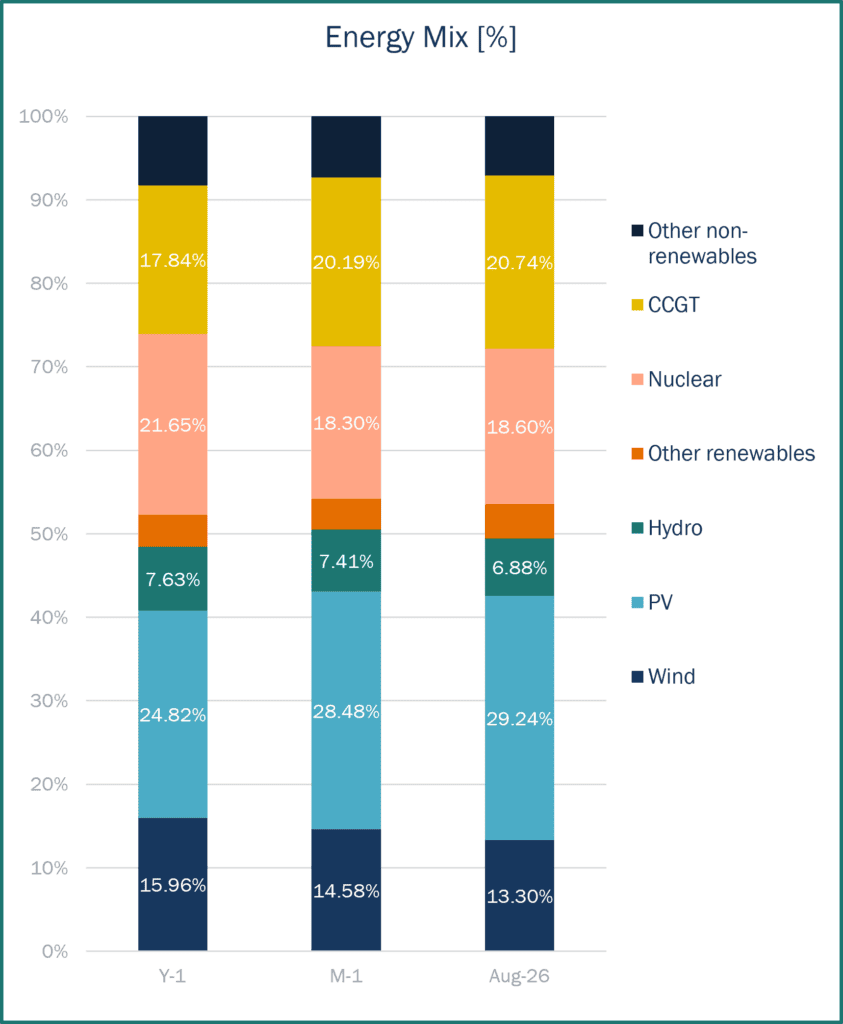
Renewables represented 53.6% of Spain’s generation mix in August 2026, down from 54.2% in July 2026, but above the 52.2% recorded in August 2025. Solar PV remained the leading generation source, accounting for 29.24% of total output. This was above both July 2026 (28.48%) and August 2025 (24.82%).
CCGTs retained their position as the second-largest generation source, reaching 20.74% of total output, slightly above the 20.19% recorded in the previous month. Nuclear ranked third, contributing 18.60% of total generation, above July 2026 (18.30%) but below August 2025 (21.65%).
A particularly relevant event for the nuclear sector during the month was the Spanish Government’s approval of the extension of operations at the Almaraz nuclear power plant until 8 June 2030. The decision affects both reactors and replaces the previously scheduled closure dates of November 2027 for Almaraz I and October 2028 for Almaraz II, extending their operating lives by approximately 31 and 19 months, respectively. Although the decision is specific to Almaraz and does not modify the scheduled closure dates of Spain’s other nuclear plants, it may signal a more flexible approach to nuclear lifetime extensions within the country’s future energy policy.
Source: Haya Energy Solutions
Overall, solar PV continued to dominate Spain’s generation mix during August, with its contribution remaining clearly above both CCGTs and nuclear. This reinforces the increasingly prominent role of solar generation within the Spanish power system.
More broadly, the generation structure in August 2026 remained very similar to that observed in July, with only marginal changes in the contribution of the main technologies and no changes in their ranking. The year-on-year comparison shows a more visible shift: nuclear was the second-largest generation source in August 2025, ahead of CCGTs, whereas this ranking was reversed in August 2026.
Energy prices & market panorama
Source: Haya Energy Solutions
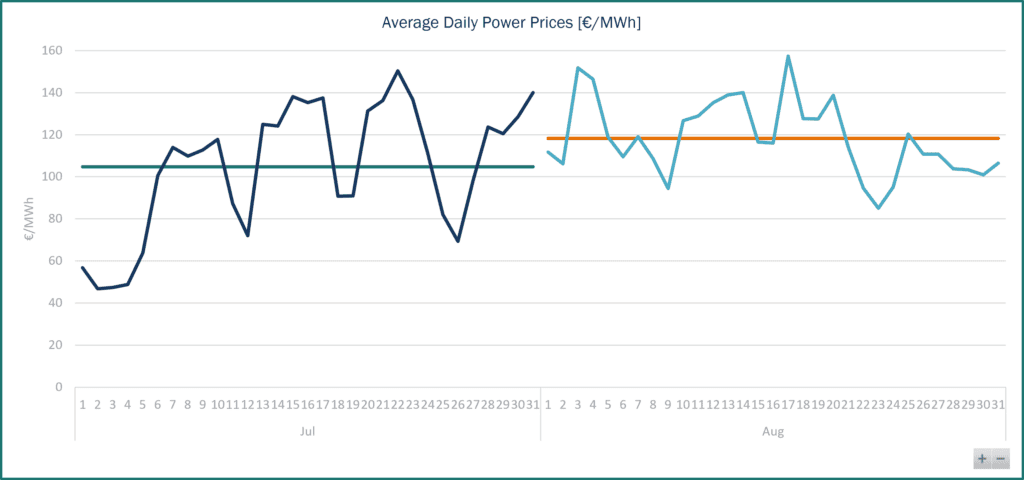
Spain’s average wholesale electricity price stood at 118.24 €/MWh in August 2026, above the 104.75 €/MWh recorded in July. This marked the fourth consecutive monthly increase in the average power price. The intraday pattern highlighted in previous editions remained in place, with solar generation continuing to depress prices during the central hours of the day before prices recovered once PV output faded. However, the overall price environment shifted markedly higher during August.
Looking at the daily average price profile, all days of the month remained above 80 €/MWh, illustrating the consistently elevated price environment. The monthly peak was reached on 17 August at 157.35 €/MWh, while the lowest daily average, 85.15 €/MWh, was recorded on 23 August. More broadly, prices showed considerable day-to-day variability. Across both July and August, the profile followed a clear “saw-tooth” pattern rather than a sustained upward or downward trend, reflecting the sensitivity of power prices to daily renewable availability. Lower wind and solar generation increased the need for gas-fired generation to cover demand, generally resulting in higher daily wholesale prices.
Despite the strong increase recorded during the month, Spain remained one of the most competitive major power markets in Europe in terms of average monthly prices. The high penetration of solar PV continued to provide an important price-mitigating effect, particularly when compared with more gas-dependent markets such as Italy, where the average wholesale electricity price reached around 180 €/MWh in August.
On the regulatory side, despite the strong increase in wholesale power prices, the 15% year-on-year electricity CPI threshold established under RDL 18/2026 was not exceeded. Consequently, the temporary reductions in electricity VAT and excise duty foreseen for August and September were not activated.
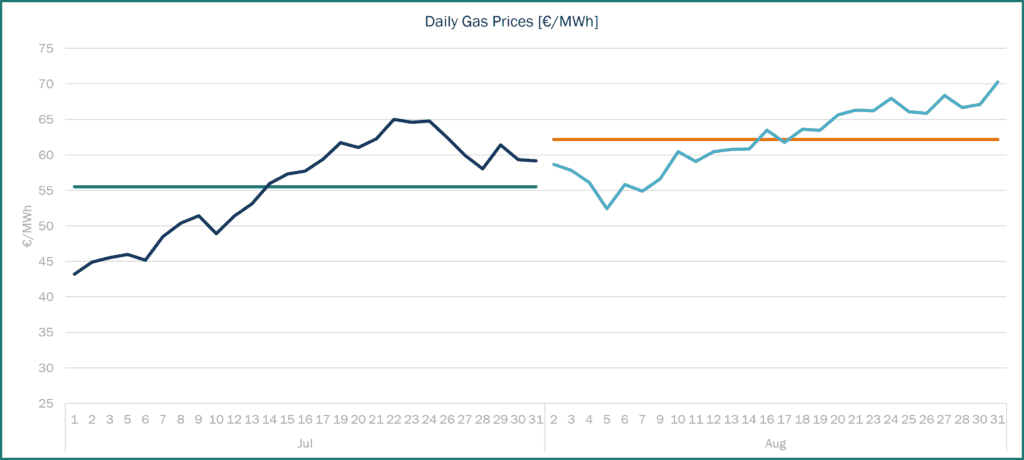
The average natural gas price in the Spanish market stood at 62.18 €/MWh in August 2026, up from 55.50 €/MWh in July. Prices followed a clear upward trend throughout the month, ultimately exceeding 70 €/MWh on 31st August, marking the highest level recorded so far in 2026. Overall, gas prices increased by around 35% between 5 and 31 August.
Source: Haya Energy Solutions
The upward move was mainly driven by renewed geopolitical tensions involving the United States, Israel and Iran, which continued to disrupt traffic through the Strait of Hormuz and constrain global LNG supply, particularly flows from Qatar. At the same time, Europe’s gradual phase-out of Russian gas imports reduced alternative supply options, while maintenance works at Norwegian facilities temporarily limited pipeline flows from Europe’s main gas supplier.
During the first half of August, expectations of a normalisation in shipping conditions weakened as US-Iran negotiations remained stalled and further tanker attacks reduced traffic through the Strait. Tensions increased further around 17 August, when the 60-day negotiation window established under the June memorandum of understanding expired without a final agreement or extension. Iran subsequently reiterated that the Strait would remain closed until the United States met the conditions of the interim agreement, while Washington confirmed that no further talks were scheduled. As a result, expectations of a rapid restoration of oil and LNG flows through Hormuz faded, reinforcing the geopolitical risk premium embedded in both natural gas and oil prices.
Market trends and futures
Source: Haya Energy Solutions
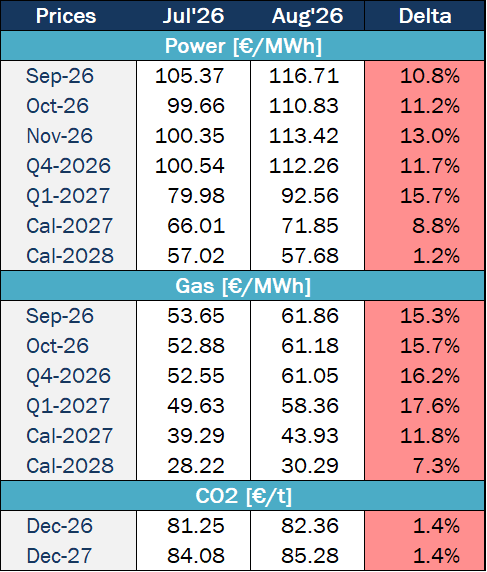
Spanish electricity forward prices moved higher across all products in August 2026, marking the fourth consecutive month of broad-based increases. The strongest increases were concentrated in the short-term products, with all monthly and quarterly contracts under review increasing by more than 10%. The largest rise was recorded in Q1-2027, which increased by more than 15%. By contrast, the longest-dated product, Cal-2028, rose by only slightly more than 1%. This divergence suggests that the market continues to interpret the current price pressures as predominantly short- to medium-term, while maintaining expectations of a more favourable environment further along the horizon.
Gas forward prices also increased across all products compared with the previous month. All monthly and quarterly contracts rose by more than 15%, while Cal-2027 also recorded an increase of more than 10%. This broad-based repricing is consistent with the developments described in the previous section, particularly the renewed geopolitical risk surrounding the conflict involving Iran and the United States, together with the progressive reduction of Russian gas imports into Europe.
Regarding storage levels, natural gas inventories in the European Union currently stand at 65.39% of capacity, around 10 percentage points above the previous month. Despite this improvement, storage remains at its lowest level for this time of year in recent years. In Spain, gas inventories stand at 73.45%, only around 1 percentage point above the previous month. However, the European gas market remains highly interconnected, meaning that higher storage levels in individual countries provide only partial insulation from broader regional and global supply pressures. Storage levels ahead of the winter season therefore remain an important driver of gas price expectations and, indirectly, of winter power prices. In this context, the recent increase in gas prices represents an additional source of pressure for the upcoming winter period.
CO₂ prices also moved higher during the month, extending the upward trend observed over the previous four months. The increase was supported by the broader bullish environment across energy markets, particularly higher gas and power prices, as well as the geopolitical risk associated with developments in the Middle East.
Regulatory developments also progressed during August. On 13 August, a draft resolution was submitted for public consultation to advance the implementation of RD 88/2026, further developing the independent aggregator framework and the operational and metering arrangements required for aggregated demand to participate in electricity markets. The proposal remains under regulatory development.