Key Insights from the French Market Analysis
Analysis of the French energy market is key to understanding the dynamics and trends affecting the sector both locally and internationally. In this detailed analysis, we address the important factors influencing energy prices, supply and demand, and the latest regulatory policies. This comprehensive overview will allow you to keep up to date with weekly changes and anticipate possible market variations, both in France and in other relevant markets such as Spain.
Table of Contents
August 2026
Key figures of the month
Source: Haya Energy Solutions
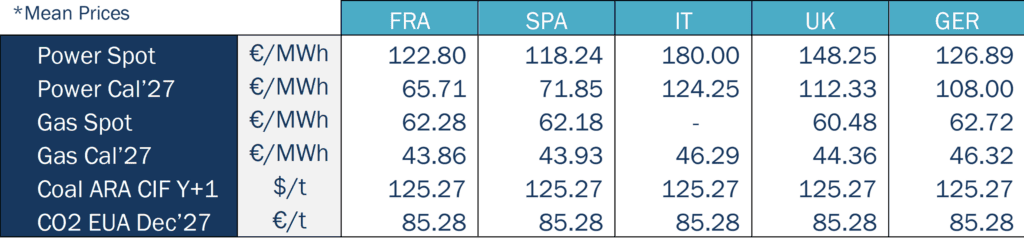
In August 2026, electricity spot prices increased sharply across most major European markets. The upward movement was also visible in the forward market, with Power Cal’27 rising across all countries, largely supported by higher gas prices. More broadly, the increase in energy prices added renewed inflationary pressure to the European economy, particularly through higher electricity and fuel costs.
Spain, France and Germany remained in the lower range of monthly average electricity prices, between 115 and 130 €/MWh. Spain was the lowest-priced power market in the region, with an average price of 118.24 €/MWh, despite an increase of around 15 €/MWh compared with July. France ranked second, averaging 122.80 €/MWh, while Germany followed at 126.89 €/MWh.
By contrast, the UK recorded an average monthly price close to 150 €/MWh. Italy once again stood out as the highest-priced market, averaging around 180 €/MWh and moving closer to the 200 €/MWh level. This reflects the Italian generation mix’s greater dependence on gas-fired technologies. As a result, sharp increases in natural gas prices, such as those observed during August, tend to feed through more directly into wholesale electricity prices.
Overall, several European power markets recorded price peaks not seen since early 2023, highlighting the magnitude of the upward repricing experienced during the month.
At the same time, August also saw new daily solar PV generation records across several major European markets. New all-time daily highs for August were reached in Germany (491 GWh), Spain (277 GWh) and France (190 GWh).
On the gas side, average spot prices stood broadly within the 60–62 €/MWh range across most markets. Compared with July, gas prices increased across all countries, while Gas Cal’27 also moved higher on a month-on-month basis across all markets.
As has been the case since the outbreak of the conflict, gas price formation remained largely driven by developments involving Iran, Israel and the United States. A more detailed review of the main developments during August and their impact on gas prices is provided in section 3.
As for CO₂, prices increased from around 84 €/t in July to 85 €/t in August, extending the upward trend observed over recent months. The monthly average in August was the highest recorded since February 2026. Overall, the month was characterised by broad-based increases across the main energy commodities, with electricity, natural gas and CO₂ all moving higher.
Energy demand and generation mix
Source: Haya Energy Solutions
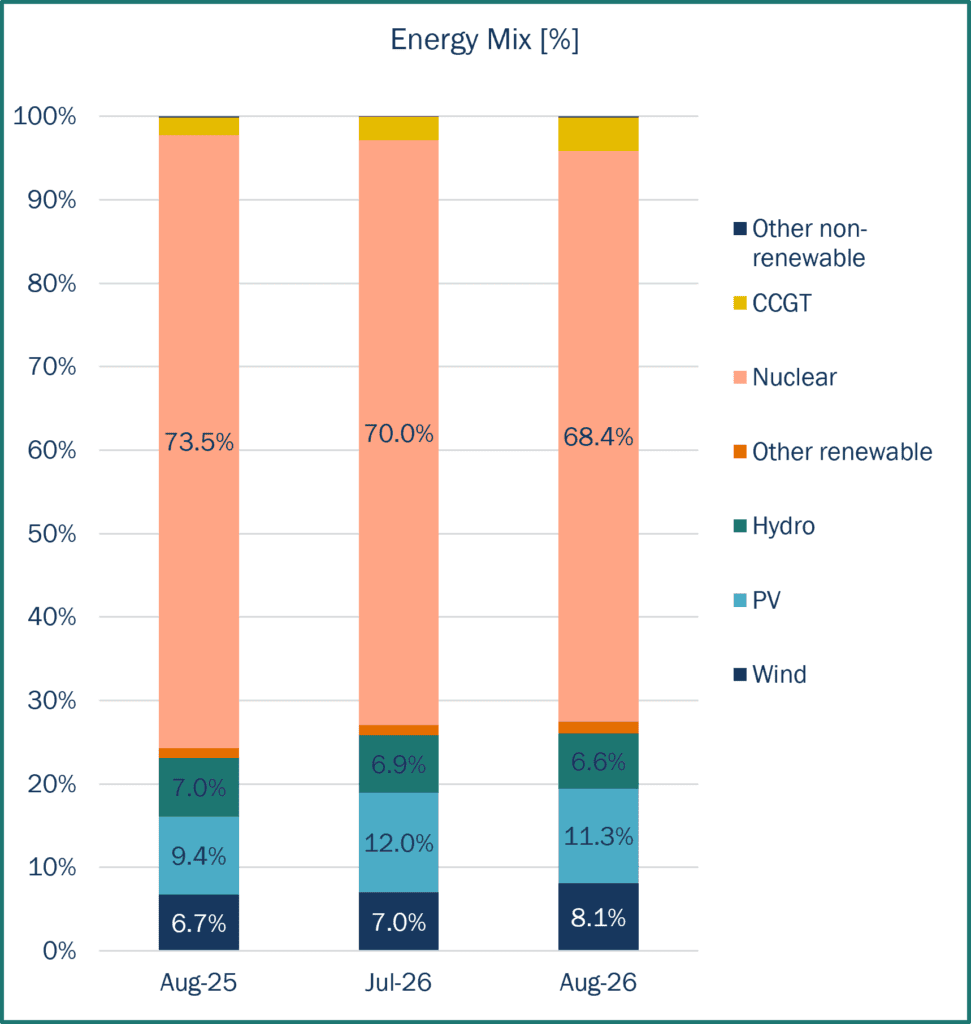
In August 2026, total generation in France reached 37,818 GWh.
Nuclear power remains the backbone of the French generation mix, playing a key role in ensuring system security of supply; it represented 68.4% of August’s energy mix. However, high temperatures affected nuclear availability during the month, as rising river temperatures led to temporary output reductions or shutdowns at several plants, including Bugey, Golfech and Tricastin, in order to comply with environmental limits on cooling-water temperatures. CCGT generation increased from 2.4% in July to 4.0% in August, providing additional flexibility during periods of lower nuclear availability. The other main technologies have been solar PV, hydro and wind generation.
Regarding renewable energy sources, the overall contribution was broadly aligned with the previous month. Solar PV was the largest renewable contributor, accounting for 11.3% of total generation. It was followed by wind generation (8.1%) and hydropower (6.6%). Overall, renewables continued to play an important role in the French power mix, with solar and wind providing the main contributions during the month. Hydroelectric stocks have decreased in the last months from 2,439 GWh at the end of June until 2,073 GWh by end August (figures until week 34 in RTE), with very low levels in comparison with the last 5 years stock level in the same period.
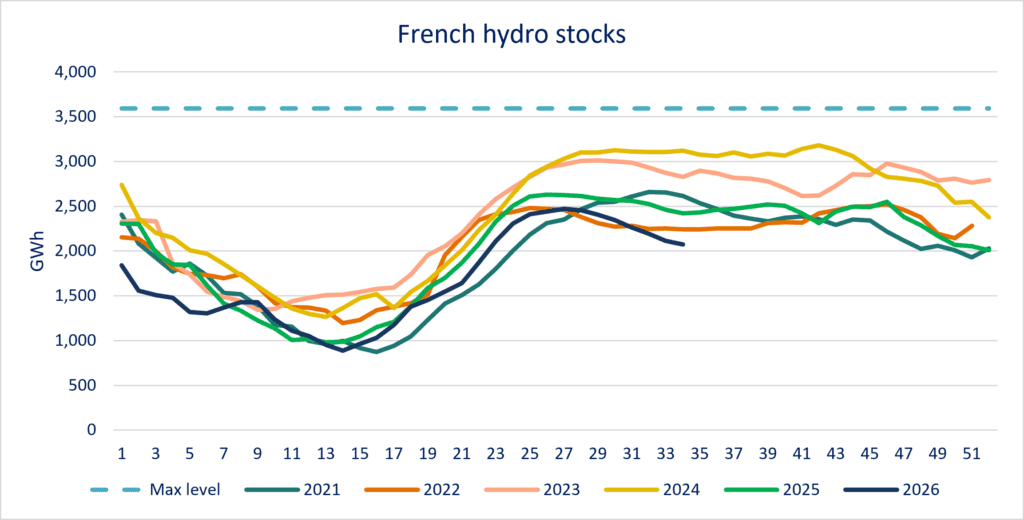
Note: Hydraulic stock represents the aggregated energy content of French lake-type hydro reservoirs, expressed as head energy (energy producible by the plant directly connected to the reservoir). Maximum stock: 3,591 GWh. Data published weekly by RTE.
Energy prices & market panorama
Power prices in August 2026 were mainly driven by high temperatures, nuclear availability and renewable output volatility. Elevated temperatures increased cooling demand and, at the same time, rising river temperatures constrained nuclear generation at several plants, adding pressure to the market.
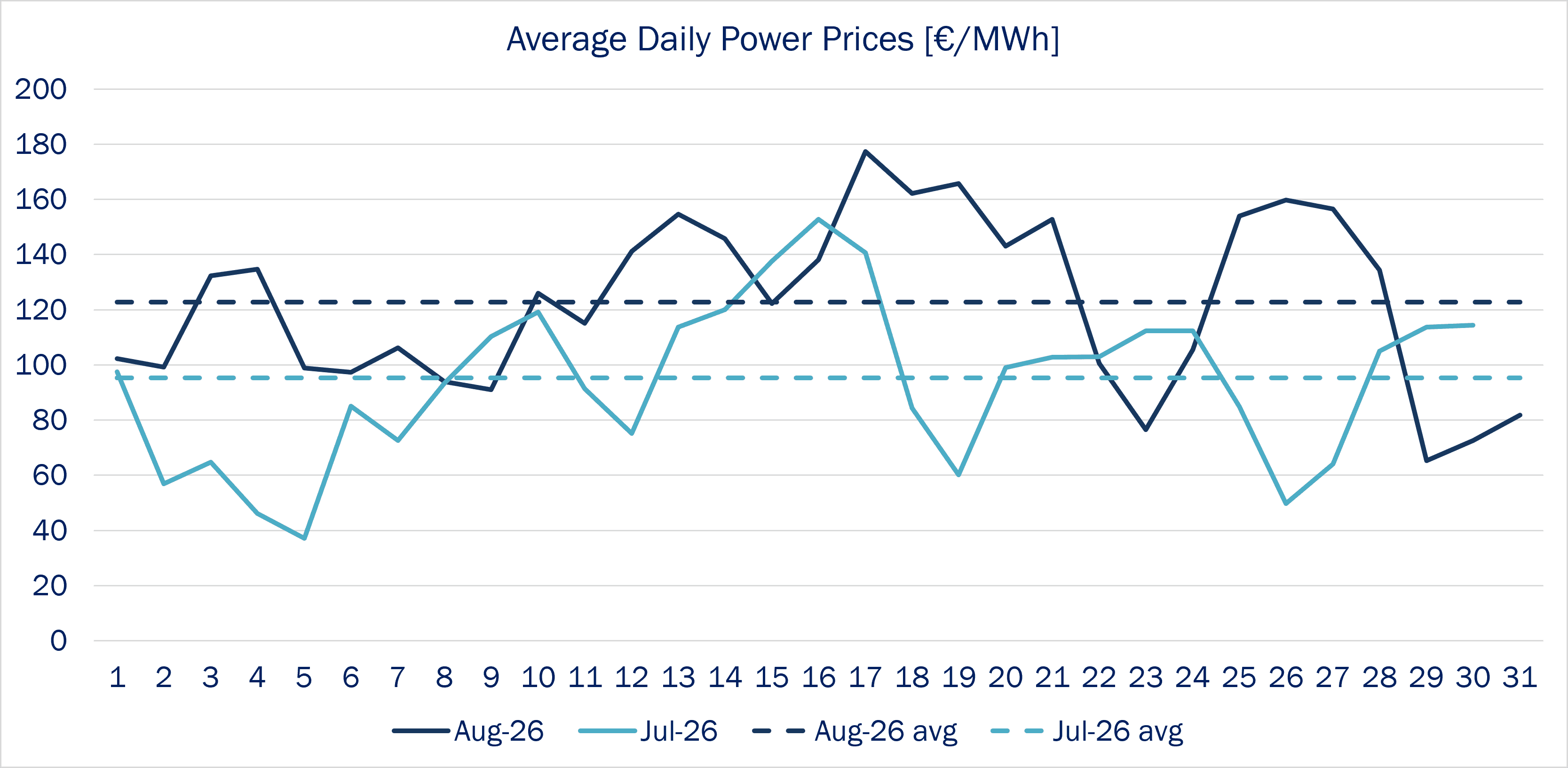
August’s average spot electricity price in France reached 122.8 €/MWh, a 29% increase compared with July’s average of 95.2 €/MWh and 125.6% above August 2025. As shown in the graph, prices fluctuated significantly throughout the month, with a minimum quarterly price of -11.3 €/MWh on 8 August at 14pm and a maximum of 487.4 €/MWh on 13 August at 19pm.
Low-price hours became less frequent than in July, with 11.9% of prices below €5/MWh, compared with 19.8% in July. In contrast, high-price periods increased significantly, with 65.8% of prices above €120/MWh, compared with 46.6% in July. This is consistent with the higher contribution of CCGT generation as well as with the strong increase in gas prices.
The intraday price pattern observed on 13 August is illustrative of a broader dynamic seen repeatedly during the last months. Strong solar generation helped depress prices around midday, but the sharp decline in solar output in the evening, while demand remained elevated, required a rapid increase in flexible generation. On 13 August, for example, solar generation fell from around 21 GW in the afternoon to 9.1 GW at 19pm. This loss of solar output had to be replaced by other technologies: gas generation rose from below 1 GW during peak solar hours to 3.5–4.1 GW in the evening, while reservoir and pumped-storage hydro also ramped up significantly. With wind output remaining relatively low and nuclear generation offering limited short-term flexibility, CCGTs were therefore more likely to set the marginal price during evening hours.
In terms of cross-border flows, France remained a net exporter across most interconnections. Hourly export levels reached c. 18 GW at peak during the month.
Source: Haya Energy Solutions
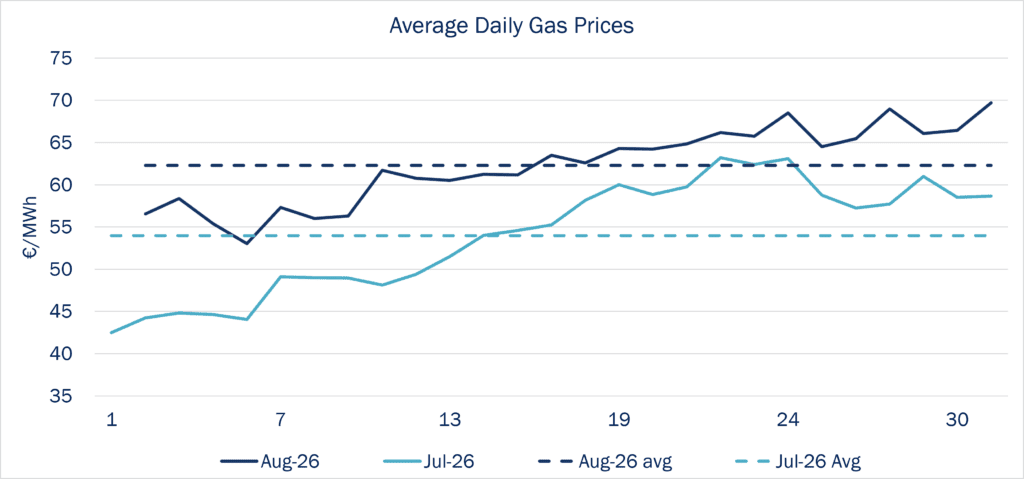
Regarding the PEG Day-Ahead spot price, August 2026 prices averaged €62.3/MWh, increasing by 15.4% compared with July’s average of €54.0/MWh, with daily prices ranging between €53.0/MWh and €69.7/MWh throughout the month. As shown in the graph, prices remained relatively firm throughout the month and strengthened particularly during the second half of August.
Gas prices were supported by a combination of tight supply fundamentals and stronger weather-driven demand. High temperatures increased gas demand for power generation, as CCGTs were increasingly required to compensate for lower nuclear availability. At the same time, the European market remained exposed to constrained LNG availability, competition for cargoes and temporary limitations in Norwegian supply, keeping prices elevated. French LNG availability had already tightened significantly ahead of August, with several scheduled cargoes diverted to other markets.
Source: Haya Energy Solutions
The storage situation also remained a key bullish factor. EU gas stocks ended August at around 65% full, well below both the 77% recorded at the same time in 2025 and the historical average of roughly 79%. France itself was around 71% full at the end of the month. This persistent storage deficit, together with uncertainties around LNG and Norwegian supply, leaves PEG prices particularly sensitive to further supply disruptions, weather conditions and competition with Asia for LNG ahead of winter.
Market trends and futures
Source: Haya Energy Solutions
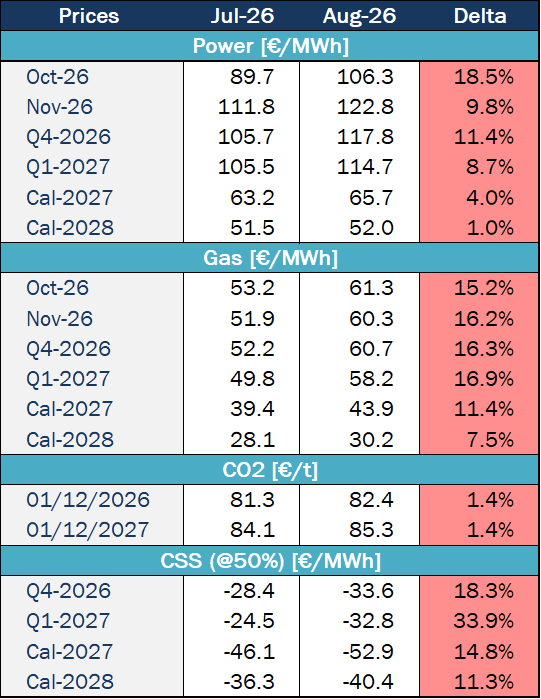
During August, French power futures moved higher across the curve, with the strongest increases concentrated in the short- and medium-term products. The move was particularly visible in Q4-2026, while longer-dated contracts remained comparatively stable. This suggests that the repricing was mainly driven by near-term winter supply concerns rather than by a structural change in the long-term French power outlook.
The main driver was the sharp increase in gas prices, combined with concerns over the French winter power balance. Gas forwards rose across the curve, with short-term contracts increasing by around 15–17%. European gas markets remain exposed to low storage levels, LNG availability and geopolitical risks, all of which have increased the risk premium ahead of winter.
This gas rally fed directly into French power forwards because gas-fired generation often sets the marginal electricity price when nuclear or renewable availability is lower. In those periods, higher gas prices translate into a higher marginal power price, especially during peak-demand hours or when renewable output falls. This dynamic became particularly relevant over the summer, when lower nuclear flexibility and the evening decline in solar generation increased the need for flexible thermal generation.
This is also reflected in the clean spark spreads, which became more negative despite higher power prices. The increase in gas and carbon costs more than offset the rise in electricity prices, worsening the economics of gas-fired generation, particularly for winter delivery periods.
Carbon prices remained comparatively stable, with only modest increases across the curve. This indicates that the recent move in French power prices was driven primarily by gas and winter supply concerns, rather than by a significant repricing of carbon.
Oil markets also retained a geopolitical risk premium, with tensions around the Strait of Hormuz continuing to pose upside risks to crude and LNG flows. Any disruption to LNG supply would likely add further pressure to European gas prices and, indirectly, to French power forwards.
Key news and implications
Capacity mechanism
France’s new centralized capacity mechanism is moving into implementation ahead of the 2026/27 delivery period. The framework is based on Decree No. 2025-1441 of 31 December 2025. More recently, Decree No. 2026-771 of 13 August 2026 introduced additional technical adjustments, clarifying eligibility and remuneration under multi-year capacity contracts. The mechanism provides for 22 Peak Days during the winter period, with capacity remunerated based on availability during periods of system stress. RTE’s preliminary estimate for the 2026/27 delivery period points to a capacity quotient of around €18,647/MW, corresponding to an estimated total mechanism cost of approximately €1.67bn. When spread across electricity consumption, this would represent an average cost impact of roughly €4/MWh for end-users.
Regulated electricity tariffs (TRVE).
The 2.5% average increase in French regulated electricity tariffs proposed by CRE in July was formally adopted through the Government Decision of 29 July 2026, published in the Journal officiel on 31 July, and entered into force on 1 August 2026. The increase reflects changes in regulated cost components, including higher network tariffs and the incorporation of the new capacity mechanism into the TRVE cost stack.