On 6 July, RTE held the first auction under the new centralised design of the French capacity mechanism for the winter delivery period 2026-2027. The auction awarded 82.45 GW at a price of €28,183/MW/year, representing a total remuneration of close to €1,394 million.
The result offers a first economic reference for the new design: the demand curve led to contracting 3.45 GW above the Cref of 79 GW and the CCGTs set the marginal price. However, the application of the PPI implies that most of the contracted capacity will receive only €15,000/MW/year.
These results come at a time when capacity mechanisms are becoming increasingly important in Europe. According to ACER, Member States allocated around 6,500 million euros to these mechanisms during 2024, although the cost borne by consumers varies very significantly between countries.
The French auction offers a new benchmark for comparing these mechanisms.
The first auction of the new French mechanism and the cost of security of supply in Europe
A year ago we analysed in our newsletter the new design of the French capacity mechanism and the move from the certificate system to a centralised model managed by RTE. This first auction now allows us to see how this design translates into economic results.
For the winter of 2026-2027, 82.45 GW were contracted, with a matching price of €28,183/MW/year and an aggregate remuneration of approximately €1,394 million. The delivery period runs from November 1, 2026 to March 31, 2027.
How do you build capacity demand?
RTE does not set a single volume of capacity to be contracted, but an elastic demand curve.
The main reference is Cref, the volume of certified capacity necessary to meet the security of supply criterion. To determine this, RTE starts from a prospective scenario of demand and the expected electricity fleet and adjusts the available capacity until this criterion is reached. For 2026-2027, this calculation results in a Cref of 79 GW.
The second reference is the CONE (Cost of New Entry), which represents the annual cost of having new capacity and stands at €60,000/MW/year. The curve is built around the point (Cref, CONE): if the available capacity is scarcer, the price increases, reinforcing the signal to maintain or incorporate capacity; if there is greater availability, the price decreases. The mechanism can thus contract a volume higher or lower than Cref depending on the price of the offers received.
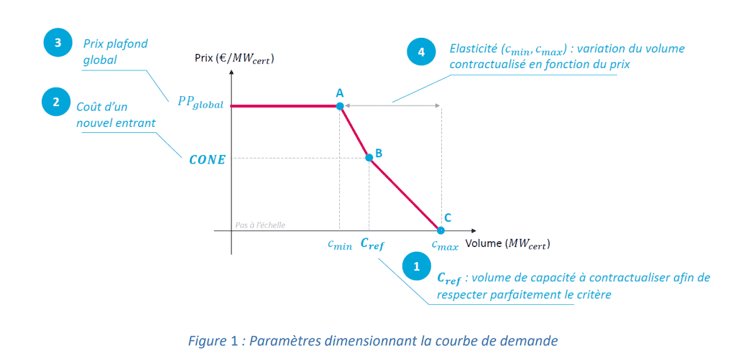
For 2026-2027, the curve is completed with a maximum price of €72,000/MW/year and an elasticity range between Cmin = 78.5 GW and Cmax = 85.5 GW. In this way, the volume finally contracted can be above or below Cref depending on the price resulting from the auction.
The sizing of the demand curve for 2026-2027 is based on the “slow decarbonisation – public targets not reached” consumption scenario of RTE’s Bilan prévisionnel.
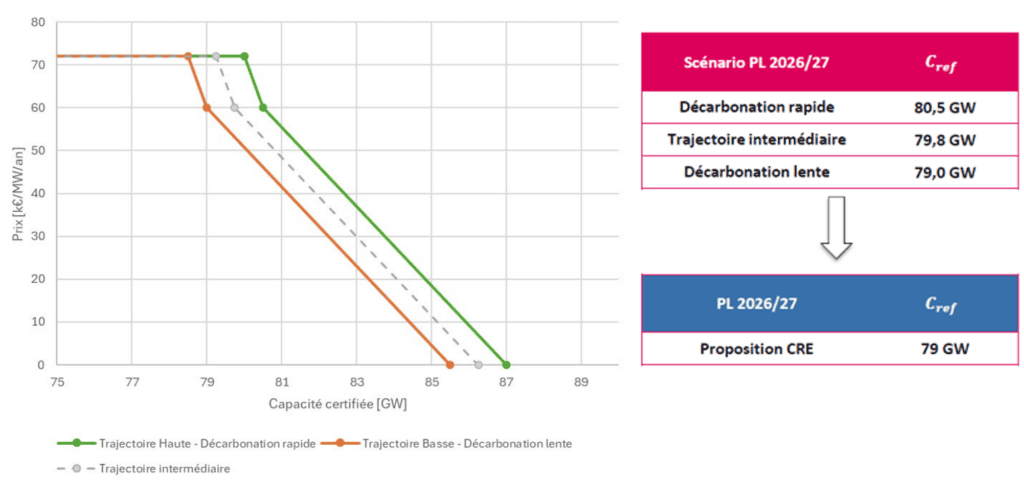
The sizing also incorporates a cross-border contribution of 14.25 GW, implicitly considered when calculating French capacity needs. The Cref therefore already takes into account the expected contribution of interconnections. The mechanism also reserves 4.7 GW for decarbonised flexibilities, including batteries, pumping and demand response.
Certification of available capacity
Before participating, installations must certify their capacity, so that the MW considered reflect their effective contribution to security of supply. An installed MW does not necessarily equate to a certified MW: RTE applies differentiated coefficients according to the technology and its characteristics.
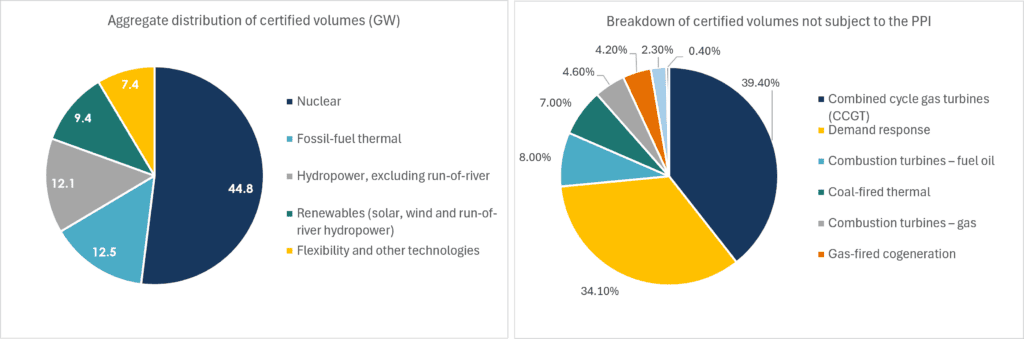
For 2026-2027, 2,164 entities were certified, equivalent to 86.20 GW, of which 86.05 GW were finally offered in the auction. The crossover between supply and demand occurred at 82.45 GW and €28,183/MW/year. Thus, 3.45 GW were contracted above Cref and combined cycle gas (CCGT) was the marginal technology.
However, €28,183/MW/year is not the remuneration for all contracted capacity. Existing generation and storage capacities are, by default, subject to the PPI (Prix Plafond Intermédiaire), which limits their remuneration to €15,000/MW/year, except for certain exemptions.
Finally, approximately 11.5 GW contracted receive the matching price, while 70.9 GW receive the PPI. As a result, the aggregate remuneration stands at approximately 1,394 million euros, significantly below that which would result from applying the matching price to the total contracted capacity.
The cost of the mechanism is passed on to consumers through suppliers, whose contribution depends on their customers’ consumption during peak periods (PPs) relevant for security of supply. As a reference, the €1,394 million is equivalent to approximately €3.1/MWh if distributed over the whole of French electricity demand.
Cost of capacity in Europe
According to ACER,[1] in 2024 around €11 billion was spent on security of supply measures in the EU, of which approximately €6.5 billion corresponded to capacity mechanisms. Auction prices differ between countries.
France, Belgium, and Italy have capacity mechanisms of general scope, while Germany currently maintains a strategic reserve. Spain already has European approval for its new mechanism, although it does not yet have auction results.
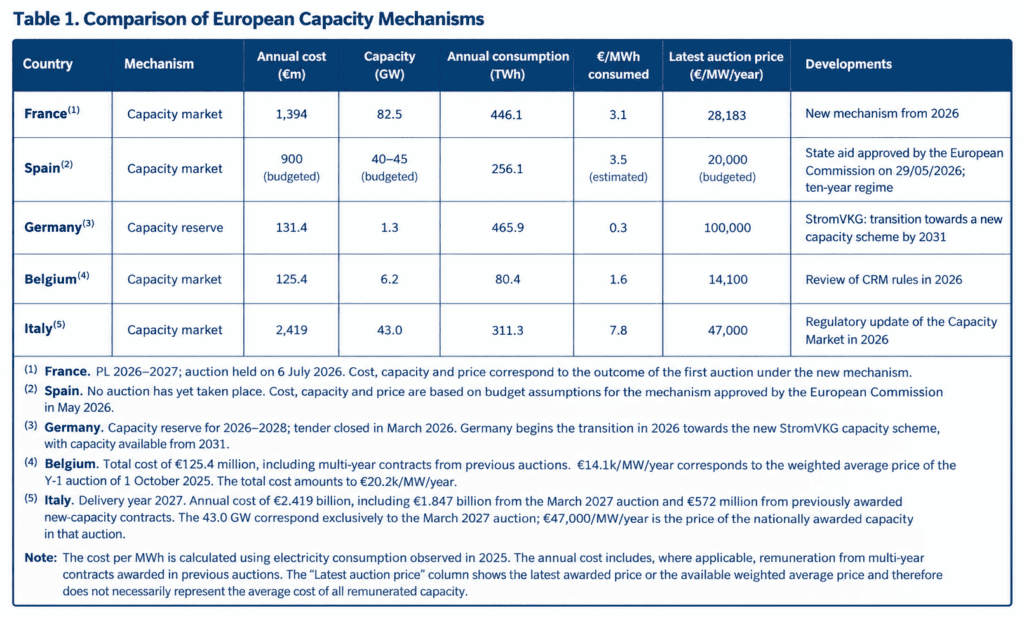
Sources: ACER, European Commission, national regulators, electricity system operators. Prepared by Haya Energy Solutions.
The comparison above shows significant differences in the cost of the mechanisms. Italy has the highest relative cost, at approximately €7.8/MWh, compared to €3.1/MWh in France and €1.6/MWh in Belgium. Germany is around €0.3/MWh, although its strategic reserve remunerates only 1.3 GW, a much lower volume than that contracted by the general scope mechanisms.
These figures are not directly equivalent. The mechanisms differ in the product contracted, remunerated volume, duration of contracts and treatment of existing and new capacity. In addition, the last auction price does not necessarily determine the annual cost of the mechanism. In Belgium, for example, the CRM for 2026-2027 assumes a cost of €125.4 million, equivalent to an average cost of €20.2 k/MW, while the weighted average price of the last Y-1 was €14.1 k/MW/year. The same effect appears in Italy, where the 2027 cost incorporates remuneration for new capacity awarded in previous auctions.
The latest price references also show substantial differences: €28.2k/MW/year in France, €14.1k/MW/year on average in the Belgian Y-1 and €47/MW/year for national capacity in the Italian Asta Madre in 2027. Spain does not yet have an observable reference, while Germany’s €100k/MW/year corresponds to a different product: a strategic capacity reserve.
Perspectives
The first auction is only the starting point of the new French mechanism. The design will evolve towards multi-year contracts for new capacity, with durations of up to 15 years for projects that meet the eligibility criteria. These contracts will introduce greater visibility into future revenues from new investments in generation, storage and flexibility.
The French experience also shows that the matching price is not sufficient to assess the cost of a capacity mechanism or the income from an asset. The volume contracted, the remuneration rules and the duration of contracts substantially change the economic result. A comparison with Belgium, Italy and Germany also shows the extent to which these parameters differ between markets.
As capacity mechanisms gain weight in Europe, their design will have an increasing influence on investment signals in firm generation, storage and flexibility. For market participants, this requires jointly analysing regulatory developments, capacity revenues and their interaction with the energy and adjustment services markets.
At Haya Energy Solutions we analyse these factors to assess future capacity prices, revenues and investment decisions in the main European energy markets.
[1] https://www.acer.europa.eu/monitoring/security-of-eu-electricity-supply-2025
Lourdes Granados Mesa