As the cold season approaches, the awareness of an increase of heat demand brings security of supply back to the forefront. Continuing HES’s annual review, we examine the strengths and vulnerabilities of Europe’s energy system ahead of winter 2026–2027.
- Conditions have changed since October 2025
Our last analysis in October 2025, highlighted favourable winter preparedness, supported by a French nuclear fleet operating at high output, ample hydropower reserves and competitively priced liquefied natural gas (LNG) imports (see our newsletter article, Energy supply security in Europe ahead of winter). One year later, disruptions in the Middle East and gas storage levels below historical norms are altering this balance. Nevertheless, on 25th September, the European Commission confirmed that EU gas supplies remained stable. Diversified imports, expanded LNG capacity and lower demand support this resilience, although competition for scarce cargoes could increase the cost of maintaining it. The key question is therefore how well Europe can absorb several simultaneous pressures, and at what cost.
In this article, we examine how Europe’s energy dependencies have evolved since 2022 energy crisis, how supply routes have adapted and what options remain to manage disruptions ahead of winter 2026-2027. We then analyse the role of gas systems, power generation capacity and flexibility resources to gauge the available margins in the face of winter shocks and the cost of maintaining security of supply.
- From Russian gas to the global LNG market: a transformed dependency
In 2021, against a market backdrop already strained by the post-Covid recovery, Russia accounted for approximately 40–47 % of European gas imports, mainly through pipelines, ahead of Norway. US LNG still played a secondary role, highlighting Europe’s heavy reliance on Russian supplies.
The 2022 crisis in Ukraine accelerated supply diversification, particularly towards LNG, which accounted for 45 % of European gas imports in 2025, of which 58 % came from the United States. This shift reduced dependence on Russian pipelines but increased Europe’s exposure to global gas markets and maritime transport risks.
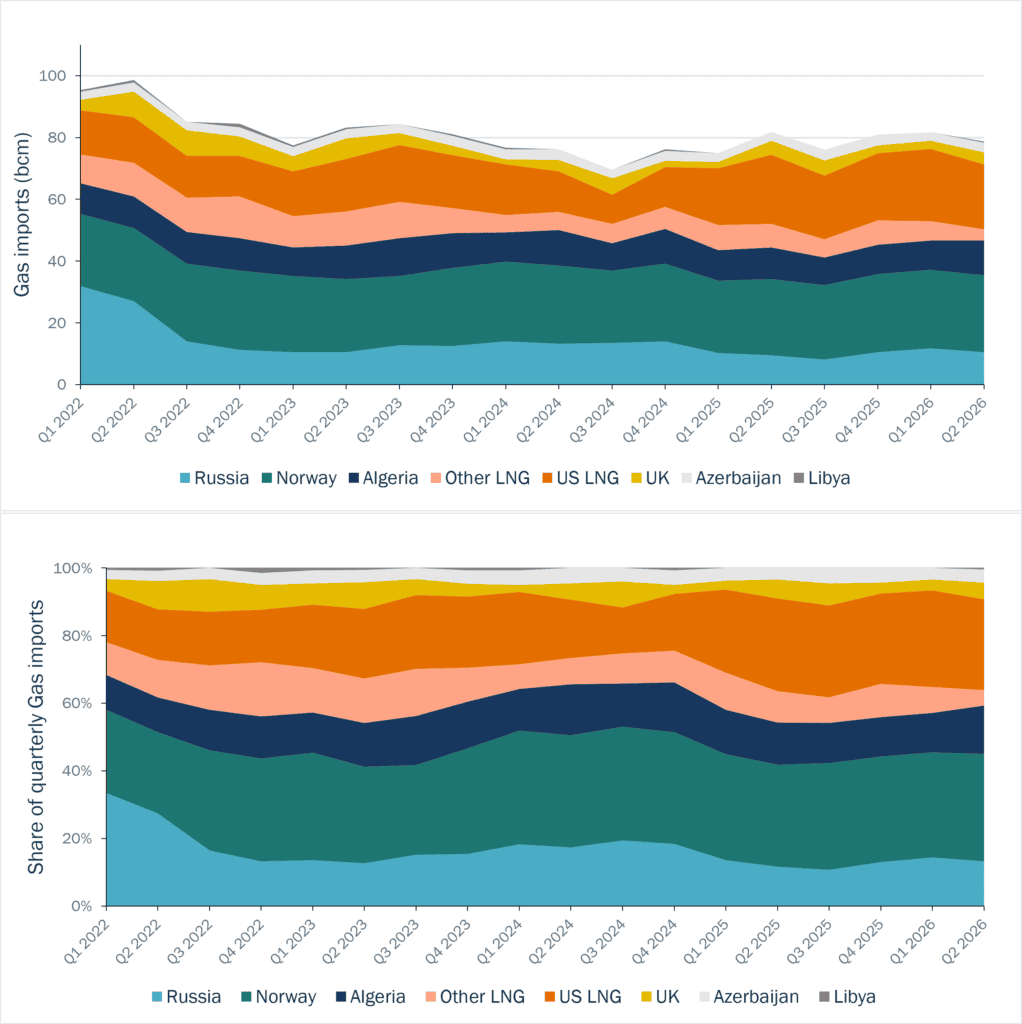
European gas imports (bcm and %) after the 2022 crisis – Source: Bruegel, based on ENTSOG, GIE and Bloomberg
In the charts above, Russian gas imports (approximately 10.4 bcm in Q2 2026) include Russian LNG and deliveries through TurkStream, which cross Turkey and enter the EU via Bulgaria. These flows have continued under the EU’s phased withdrawal: short-term LNG contracts were banned from 25th of April 2026 and short-term pipeline contracts from 17th of June 2026, followed by long-term LNG contracts from 1 January 2027 and long-term pipeline contracts from 30th of September 2027 (with a possible extension to 1 November).
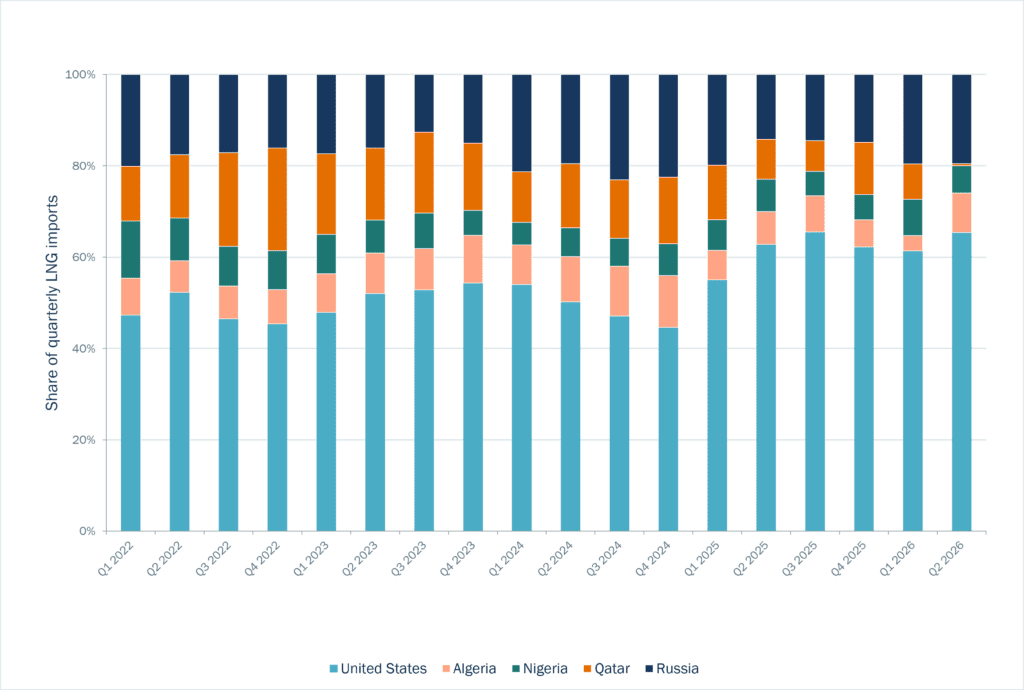
European LNG imports ( %) after the 2022 crisis – Source: Eurostat
The 2026 shock in the Strait of Hormuz, through which nearly 20 % of global LNG supply previously passed, illustrates this vulnerability: in Q2 2026, the United States supplied 63.2 % of European LNG (5 % more than 2025), even as total volumes fell by 5.6 % compared with the 2025 average. LNG imports from other origins declined, notably from Qatar, whose share fell from 10.1 % in Q4 2025 to 0.3 % in Q2 2026.
Europe has reduced the concentration risk associated with Russian pipeline gas, but this has increased its exposure to fluctuations in the global LNG market.
Alternative routes: different solutions for and gas
Beyond supplier diversification, European energy security also depends on transport routes. As discussed in our March article on the Strait of Hormuz, concentrating energy flows through a few strategic chokepoints leaves global markets exposed when regional conflicts disrupt these routes.
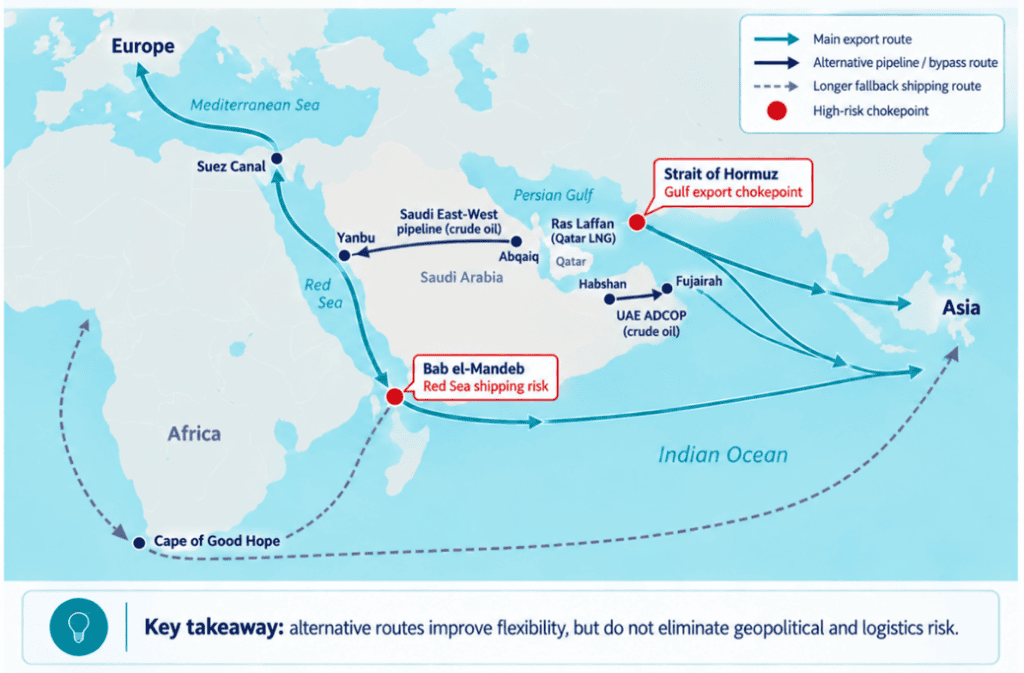
Middle East oil flows: key chokepoints and alternative routes – Source: HES diagram based on IEA and EIA data
Saudi Arabia’s East–West pipeline (Yanbu) and the UAE’s ADCOP pipeline (Fujairah) allow some oil exports to bypass Hormuz, but do not eliminate logistical risks. Their effectiveness depends on usable capacity and the security of onward shipping routes, particularly in the Red Sea and around Bab el-Mandeb and Suez. The resumption of loading at Yanbu in late September, following an interruption, illustrates this vulnerability: bypassing one strategic chokepoint can shift risk rather than eliminate it.
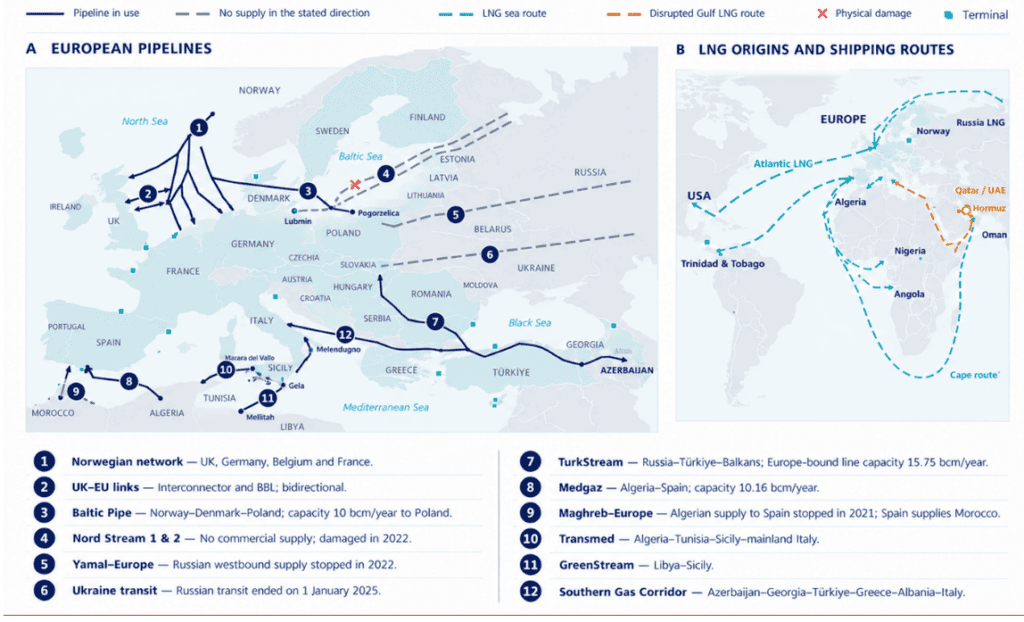
Europe’s gas import routes – Source: HES diagram based on ENTSOG, IEA and ACER data
Europe now has a diversified gas supply network, combining Norwegian, Algerian and Azerbaijani pipelines, residual Russian deliveries via TurkStream and LNG imports. This diversification increases system flexibility, but Europe remains exposed to international tensions, particularly for Qatari LNG, whose exports completely depend on transit through Hormuz.
How has the energy system absorbed such a major shock?
The disruption to the global energy system this year has been substantial. Its scale might have suggested widespread supply shortages. This has not happened, thanks to several buffering mechanisms.
First, additional supply from outside the Gulf has been boosted by the ramp-up of projects in North America and Africa. According to the IEA, between March and June 2026, LNG production outside the Gulf increased by around 27 bcm year on year, offsetting nearly three-quarters of the 35 bcm lost from Qatar and the United Arab Emirates. The global shortfall was therefore limited to around 8 bcm over the period.
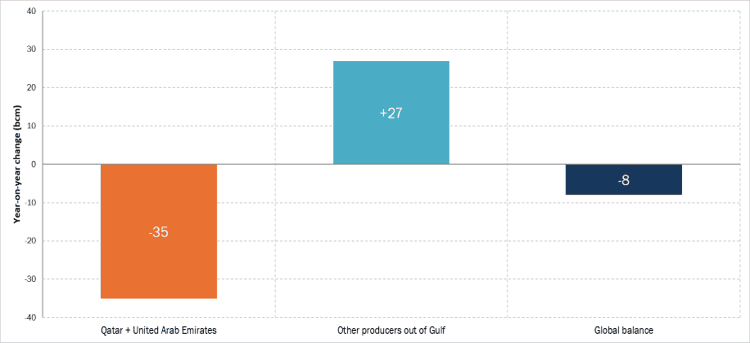
Global LNG: losses and offsetting supply (bcm) – Source: IEA
Second, in Asia, the IEA notes fuel switching and consumption reductions in response to high prices. In China, LNG imports fell by 12 % year on year as domestic production increased.
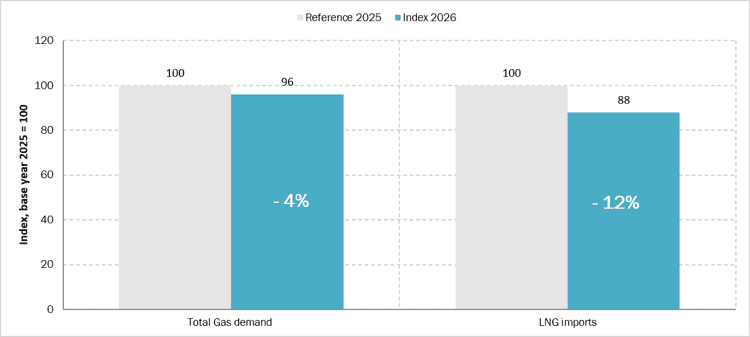
China’s total gas demand and LNG imports – Source: IEA
The outlook remains uncertain, however: in its 24th September analysis, Kpler expected Chinese demand to rebound in the fourth quarter, driven by heating needs and less favourable domestic and pipeline supply. By contrast, Argus expects Chinese spot LNG demand to remain limited this winter, supported by domestic production, Russian supplies, and potentially milder temperatures. In Japan, stronger nuclear generation and increased coal use could also reduce LNG imports by around one million tons.
For Europe, the evolution of Asian demand will be a key factor: weaker demand could ease competition for flexible cargoes and help limit prices, while a rebound in consumption—particularly in the event of simultaneous cold weather—would increase pressure on the European market.
These mechanisms have bought time, but their limitations are becoming critical: Europe must be able to get through winter even if Asian demand rebounds and inventories continue to fall. Our November newsletter will provide a detailed overview of the LNG market.
- Winter outlook: securing energy, meeting peak demand and managing costs
Security of supply rests on three complementary requirements: having enough energy throughout the season, mobilising sufficient capacity at critical hours and delivering that energy to consumers. Storage levels, generation capacity and flexibility must therefore be assessed together.
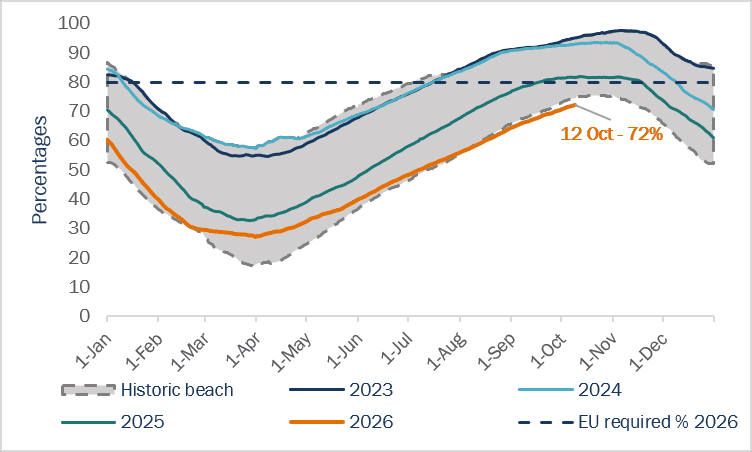
European gas storage filling levels (%) – Source: AGSIE
On 1st of October, EU gas storage facilities held approximately 811 TWh, equivalent to 72 % of capacity, compared with 940 TWh and 83 % a year earlier. This gap narrows the buffer ahead of winter withdrawals. ENTSOG published its winter supply outlook on 8th October. According to the report, to meet demand during a severe winter while maintaining storage at 20 % at the end of winter, Europe would require around 124 bcm of additional LNG supply, that is nearly 50 % more than the 83 billion imported last winter, which was already a record. Under baseline winter demand and minimised Russian pipeline flows, end-March storage levels would reach 29 % in the “LNG Optimal” scenario, compared with 13 % in “LNG Tight” A “LNG tight” scenario assumes 20 % less LNG availability and a cold winter would increase pression further.
Furthermore, the scope for offsetting supply via gas pipelines remains limited: according to Argus, Norwegian exports to the rest of Europe are expected to rise only marginally this winter, whilst Algeria is said to have little spare capacity, apart from a slight increase in deliveries to Spain.
French nuclear availability is a key link between electricity and gas security this winter. Argus reports schedule 52.2 GW available for the remaining winter period, 2.9 GW below a year earlier, with outage concentrated in Q4. Delivery remains uncertain: last winter, scheduled unavailability was revised upwards by around 5 GW. EDF maintains its annual production forecast of 350–370 TWh for both 2026 and 2027, but this does not guarantee availability during winter peaks. Restart delays would increase reliance on other resources, including combined-cycle gas turbines (CCGTs), raising gas demand and potentially prices.
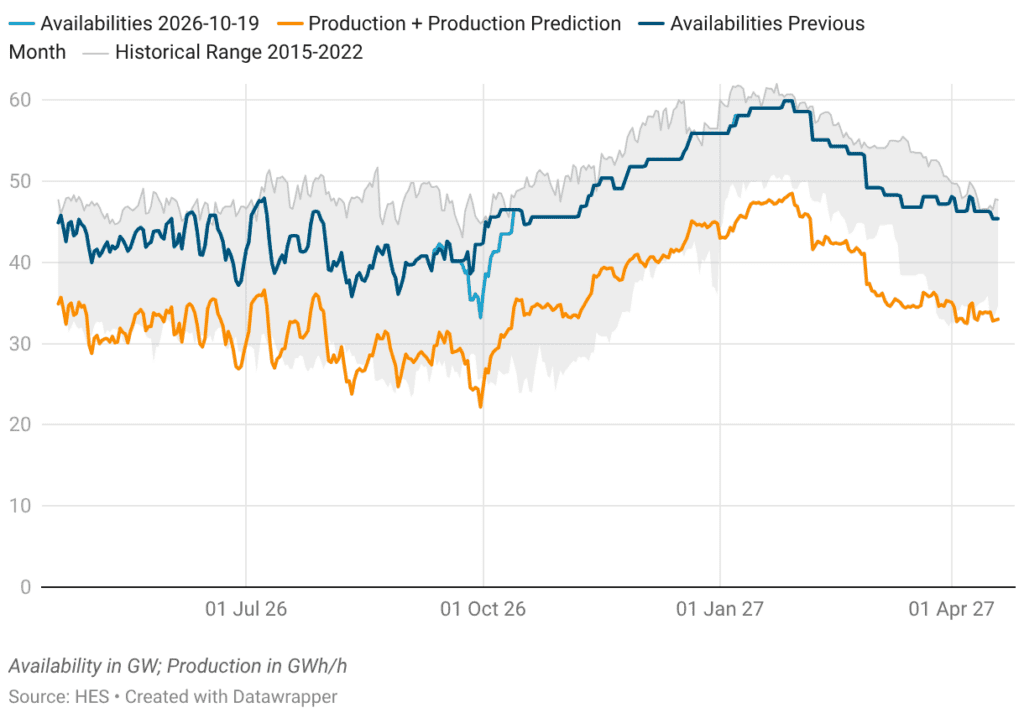
Nuclear availability and generation – Source: RTE; generation forecasts – Source: HES
European hydropower reserves stood at 116 TWh on 12th October, below the seasonal norm and the levels observed in 2024 and 2025. This reduces power-system flexibility ahead of winter, particularly when covering demand peaks. With wind generation already low, or in the event of severe cold, greater reliance on thermal power plants and imports could intensify upward pressure on electricity prices.
Argus reports exceptionally low seasonal reservoirs in France and Switzerland, alongside Austrian run-of-river generation at its lowest in over nine years. These conditions could increase neighbouring countries’ reliance on German thermal generation and exports this winter.
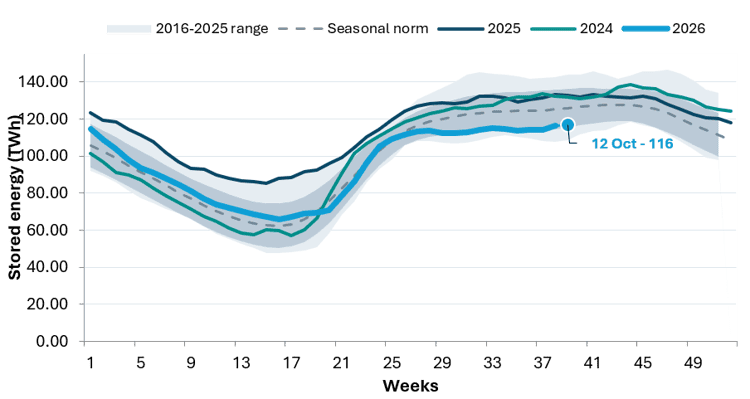
European hydropower reserves: aggregate of Spain, Italy, France, Switzerland and the Nordic countries (Norway, Sweden and Finland) – Source: ENTSO-E
Cross-border electricity support also depends on neighbouring countries’ available resources and interconnection capacity. This security also comes at a cost, as discussed in our September newsletter (How much does it cost to ensure security of supply in Europe?). Q4 2026 and Q1 2027 gas and electricity contracts should be compared at equivalent delivery periods. Higher prices may reflect more expensive fuel or greater uncertainty; they do not directly indicate the probability of a shortage.
Finally, NOAA’s 8th October bulletin confirms a strengthening of El Niño for autumn–winter 2026–2027. This global signal provides additional context alongside European forecasts. Its effects on the global LNG market could be mixed. A milder winter in Asia, particularly in China, could reduce heating demand, ease competition for available cargoes, and alleviate pressure on European prices. Conversely, drought conditions in Latin America could reduce hydropower generation and increase gas import needs, while the navigation restrictions already observed in the Panama Canal could complicate certain supply routes. The overall impact will therefore depend on the balance between these different effects.
As winter 2026–2027 approaches, Europe retains room to adapt but remains vulnerable to a build-up of supply- and demand-side pressures. In the long term, the challenge is not to eliminate interdependence but to reduce the energy system’s exposure to external risks, gradual transition that every new crisis will put to the test. In our next article, we will have an overview on LNG and its disruptions after the conflict.
Félicité Male Segnou